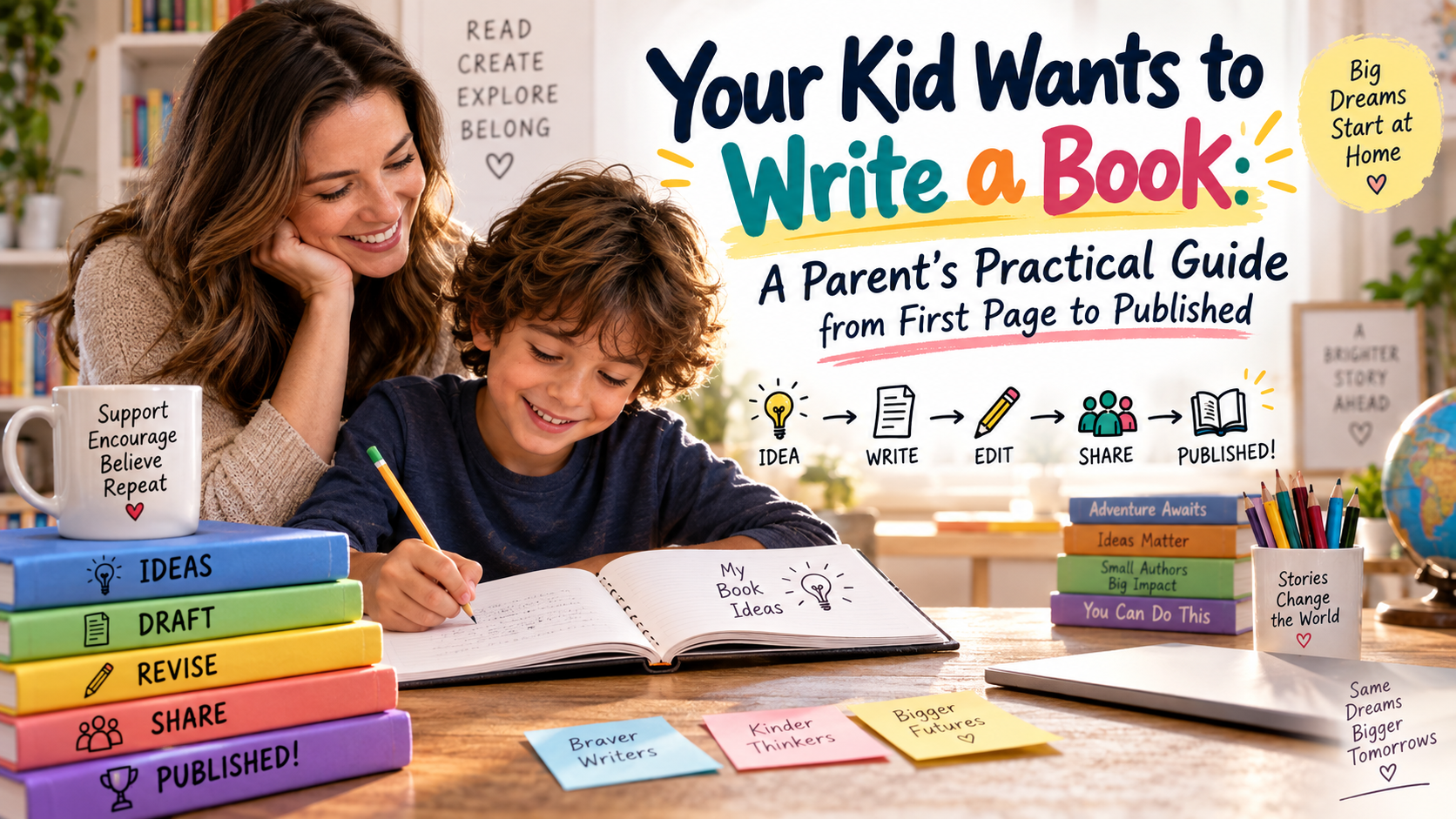
Somewhere between the ages of nine and sixteen, a lot of children announce that they’re writing a book.
Most parents respond the same way — warm encouragement, mild skepticism, and a quiet assumption that this will pass like the ukulele phase. Usually it does. But not always, and the difference between the ones that fade and the ones that end up as a finished book on a shelf has surprisingly little to do with how naturally gifted the child is.
It has almost everything to do with what the adults around them do in the first three months.
This guide is the practical version: what actually helps, what accidentally kills the project, and the specific grown-up logistics you’ll eventually have to handle if your child gets all the way to publishing.
Stage 1: Protect the enthusiasm before you improve the writing
The single most common way a parent ends a child’s book is by being helpful too early.
Your child shows you three pages. The pages have spelling errors, a plot that contradicts itself, and a character whose name changes halfway through. Your instinct is to help — gently, kindly, constructively.
Don’t. Not yet.
A first draft is not a piece of work to be assessed. It’s momentum being built, and momentum is fragile in a way that finished work isn’t. Children who get edited during drafting learn that writing produces correction, and they stop showing you pages. Shortly after that, they stop writing them.
What to say instead of feedback:
- “What happens next?”
- “Which part was the most fun to write?”
- “Wait, is he lying to her? I need to know.”
You are not lowering your standards. You’re sequencing them. Editing is a real and necessary stage — it just comes after the story exists, and it comes from a reader who’s been invited to critique, not ambushed into it.
When your child eventually asks for feedback, ask them what kind they want: “Do you want me to tell you if it’s working, or do you want me to fix the commas?” Those are different jobs, and letting them choose keeps them in control of their own project.
Stage 2: Replace inspiration with a schedule
Children are told constantly that writing comes from inspiration. It’s an appealing idea and it’s the reason most unfinished manuscripts are unfinished.
The fix is a word count so small it’s almost embarrassing. Two hundred words a day. Three hundred on a good day. Fifty on an exam week.
Two hundred words is roughly fifteen minutes. At that pace, a middle-grade novel is finished in about seven months — with days off, with holidays, with weeks where nothing happens. Most children dramatically overestimate what they can do in a weekend and dramatically underestimate what they can do in a season.
Two rules make the schedule stick:
The gap matters more than the amount. Missing a day is fine. Missing a week means re-reading everything to remember where the story was, which is the friction point where projects quietly die. Something — even fifty words — is structurally different from nothing.
A deadline that isn’t yours. “Finish by summer” is vague. “Read the first chapter aloud at Grandma’s birthday” is a date with an audience, and it’s remarkable how much that focuses a twelve-year-old.
Stage 3: Expect the middle slump, and name it in advance
Around a third of the way in, nearly every young writer decides their book is bad.
This is not a sign that the book is bad. It’s a completely standard stage that professional novelists also experience and complain about publicly. The opening was exciting because it had been imagined for months. The middle is unfamiliar territory, and comparing your rough middle to the polished published books on your shelf is a losing game every time.
Tell your child this before it happens. A predicted difficulty is enormously easier to survive than a surprising one. When they hit it, they’ll recognize it as a stage rather than a verdict.
Practical rescues for the slump:
- Skip ahead. Let them write the scene they’re excited about, even if it’s near the end. First drafts don’t have to be assembled in order.
- Read backwards. Have them read the last two chapters aloud. Hearing it usually reveals it’s better than they remembered.
- Lower the target temporarily. Fifty words a day for a week is a valid strategy, not a failure.
Stage 4: Find readers who aren’t you
At some point the draft is done and it needs real readers. This is where parents hit a genuine limit: you cannot be an objective reader of your own child’s novel, and your child knows it. Your praise, however sincere, doesn’t carry information.
Better readers:
- Friends in the target age range. If the book is for eleven-year-olds, eleven-year-olds are the experts. Their feedback is blunt and extremely accurate.
- A teacher or librarian who’s offered. They read constantly and they know what lands with this age group.
- One adult who reads that genre. Not for encouragement — for structure.
Give readers a specific question. “What did you think?” produces “it was good.” “Where did you get bored?” produces something usable.
Stage 5: The grown-up logistics you’ll have to handle
If the project reaches publication, several things legally and practically land on you. Better to know them early.
The publishing account belongs to an adult. Self-publishing platforms require account holders to be over 18. That means the account, the tax information, and the linked bank account are yours, held on your child’s behalf. Set this up calmly in advance rather than in the excited final week.
Decide the name question deliberately. Publishing puts a child’s name into a permanently searchable public record, attached to a photo and a biography. Some families are entirely comfortable with this; others use a first name only, or a pen name. There’s no correct answer, but it’s a decision to make consciously rather than by default at the upload screen.
Create a separate author email. Do not use your child’s personal address, and don’t use your main one either. Publishing generates a genuinely large volume of mail — platform notifications, reviewers, promotional services, and a fair amount of spam from vendors who scrape new author listings.
Related: the run-up to publishing involves signing up for a lot of tools you’ll use exactly once — cover mockup generators, formatting converters, free template downloads that demand an address before they’ll give you the file. For those one-time trials, a disposable email address keeps the junk away from the account where actual readers and reviewers will be writing to you. It’s a small habit that keeps the important inbox usable six months later, which matters more than it sounds like it does.
Stage 6: The title is a business decision wearing a creative costume
Children choose titles emotionally. The title means something to them, it references an inside detail from chapter nineteen, and it’s often completely opaque to anyone who hasn’t read the book.
A title has jobs beyond meaning something. It has to signal the genre in about two seconds, be readable as a thumbnail on a phone screen, be repeatable out loud when a friend recommends it, and be findable when someone half-remembers it and types it into a search bar.
A workable process:
- Generate widely without judging. Thirty or forty candidates. Quantity first. When the well runs dry, running the book’s themes through a name-idea tool shakes loose combinations you wouldn’t reach by staring at a page — most will be unusable, and one or two will reframe the whole thing.
- Test it out loud. Say each finalist in a real sentence: “It’s called ___, you’d love it.” Awkward titles reveal themselves instantly.
- Check the crowding. This is the step nearly everyone skips. Before committing, check how many similar titles and brands already occupy that space — because launching a book with a name that’s already crowded means readers searching for it find someone else’s work first. It’s a fixable problem before publication and an expensive one afterwards.
Stage 7: Build the small website
You don’t need a big one. You need a real one.
A product listing sells a copy. A website does the things a listing can’t: it gives a teacher somewhere to look before recommending the book to a class, a librarian somewhere to verify who wrote it, a local journalist a contact address, and readers who finished the book a place to find out what’s next.
Five pages is plenty — home, about the author, about the book, a blog, contact. The blog matters more than people expect: it’s the only part of the site that can bring in readers who’ve never heard of the book, and a young author’s writing-process posts are genuinely interesting to other parents, teachers, and aspiring writers.
One technical step not to skip: make sure search engines can actually crawl the site. A site that isn’t indexed is invisible regardless of how good it looks. Generating a proper sitemap file and submitting it to search engines takes about fifteen minutes, and it’s the most common omission on new author websites.
Start the website before publication, not after. Every person who says “tell me when it’s out” is someone you lose if you have nowhere to collect their email address.
Stage 8: Launch in the room you’re already in
First-time authors imagine launch as an internet event. In practice, the first hundred readers almost always come from the physical world around the author.
Places that say yes far more often than people expect:
- The school. A student author is a genuinely good assembly, and English teachers love a real example of a finished project.
- Public libraries. Local author events are part of their mandate. Many actively want young local authors and get very few requests.
- Book clubs and reading groups for the right age range.
- Community organizations and cultural associations, which celebrate young achievers and whose newsletters are read carefully by exactly the parents who buy books for children.
The pitch is simple and doesn’t require any marketing skill: a student wrote and published a novel, and would love to talk about how.
Stage 9: Set the expectation about sales, early and kindly
This is the conversation that protects your child from the only genuinely painful part of publishing.
Most first books sell modestly. Not because they’re bad — because discovery is difficult and nobody knows the book exists yet. If your child is expecting a bestseller, month two is going to be brutal.
Reframe the metric in advance. The achievement is the finished book. Tens of thousands of adults have started a novel and not finished one; your child did the hard part, and they did it while managing school. Sales are a separate game with separate rules, learned over years, and they have plenty of time.
Celebrate the upload day. Frame everything after it as learning.
What your child actually takes away
Whether the book sells five copies or five hundred, the durable outcome is the same: they learned they can finish something large.
That’s not a writing skill. It’s the thing that transfers — the understanding that big projects are just small consistent sessions stacked up, that the middle always feels like failure, and that finishing is a decision rather than a feeling.
Books get outgrown. That doesn’t.