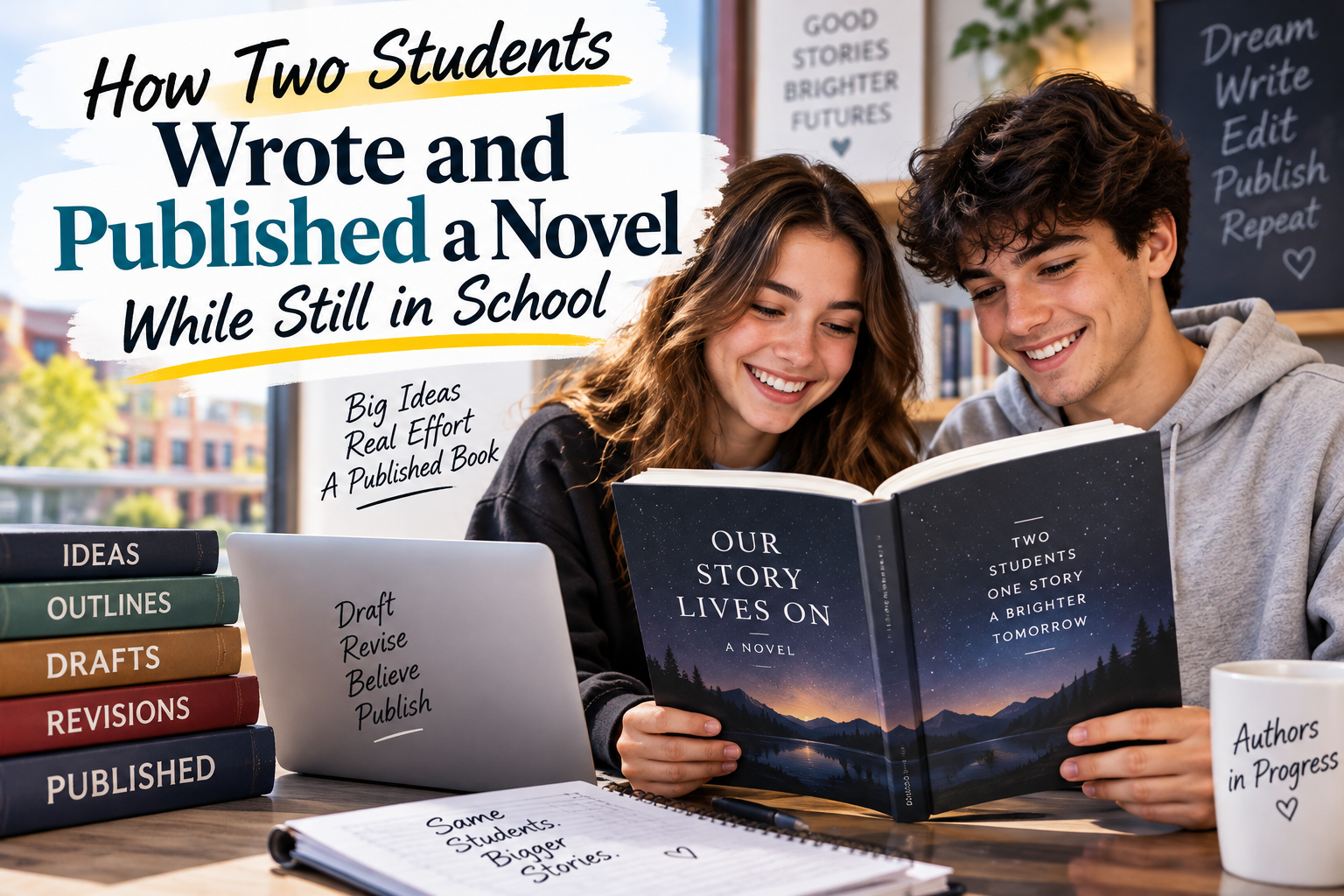
Most people assume a novel is something you write later. After college. After a “real” career. After you have the kind of life experience that supposedly earns you the right to tell a story.
We wrote ours between homework, exams, and a group chat that never slept.
Element Academy started as a conversation and turned into a published book — and the distance between those two things was not talent, or connections, or luck. It was a series of small, unglamorous decisions repeated over months. This post is the honest version of that process: what actually worked, what wasted our time, and what we’d tell anyone sitting on an idea right now.
It started because we couldn’t find the book we wanted to read
Every writing guide tells you to write what you know. We’d argue the better advice is to write what you miss.
We wanted a story about an ordinary girl who finds out her world isn’t ordinary — but we wanted it to move fast, feel warm, and not take two hundred pages to get going. We kept describing this book to each other. Eventually one of us said the obvious thing: nobody’s going to write it for us.
That’s the first real lesson. An idea doesn’t have to be original to be worth writing. Amaya’s story sits in a genre with a hundred other magic-school books, and that’s fine. Readers don’t want unheard-of. They want this specific voice, telling it this specific way. Your version is the original part.
If you’re waiting for an idea nobody has ever had, you’ll wait forever. Pick the story you keep thinking about and start.
Co-writing: the part everyone warns you about
We got told repeatedly that writing a book with a friend is a fast way to lose a friend. That’s true if you don’t set rules early. Here’s what saved us.
We split by character and scene, not by word count. Trying to write alternate chapters sounds neat and falls apart in week two, because chapters aren’t equal in weight. Instead, whoever was more excited about a scene wrote the first draft of it. Excitement produces better first drafts than obligation does, every single time.
One shared document, always. No exporting, no “I’ll send you my version tonight.” Two versions of a manuscript is how you lose a week reconciling them.
We agreed on a disagreement rule before we needed one. If we disagreed about a plot point, whoever felt more strongly won — but they had to explain why the story needed it, not why they liked it. It sounds formal. It stopped roughly fifteen arguments from becoming real ones.
We separated writing from judging. During drafting, no criticism. Comments only. You cannot draft and edit in the same breath, and you definitely can’t do it to someone else’s paragraph while they’re still mid-scene.
The underrated benefit of co-writing: you can’t quietly quit. When one of us stalled, the other had already written the next scene and was waiting. Accountability you didn’t ask for is still accountability.
The middle is where books die
Everyone romanticizes starting. Nobody warns you about chapter eleven.
The opening chapters write themselves because you’ve imagined them a hundred times. The ending is exciting because it’s the payoff. The middle is a long stretch of connective tissue where you genuinely do not know whether the book is good, and you start suspecting it isn’t.
What got us through:
A word count so small it felt silly. Three hundred words a day. On exam weeks, one hundred. The point isn’t volume — it’s never letting the gap between sessions grow long enough that you lose the thread of the story.
Writing out of order. Stuck on a transitional scene? Skip it. Write the confrontation you’re dying to write and come back. A first draft is not a performance. Nobody is watching you build it.
Permission to write it badly. Our actual rule: get it wrong on the page. A bad scene can be fixed in twenty minutes. A blank page can’t be fixed at all.
Reading our own book. Every few weeks we’d read the last fifty pages straight through, as readers. It reminded us that the thing existed — that it was a real story with real momentum, not just a document we were arguing about.
Choosing the title took longer than some chapters
This surprised us. We had the full manuscript and no title, and we lost genuine weeks to it.
A title is doing more work than it looks like. It has to signal genre in about two seconds, survive being shrunk to thumbnail size on a phone, be pronounceable when someone recommends it out loud, and be findable when they try to search for it later.
Our process, in the end, was less agonizing and more systematic:
We generated volume first. Forty candidates, no filtering, no judgment — just the shape of every phrase that could describe the book. When we ran dry, we ran the core concepts through an AI name generator to get unexpected combinations we wouldn’t have reached on our own. Most were unusable. A handful reframed how we were thinking about the book entirely, which is really what brainstorming tools are for.
Then we did the step most first-time authors skip: we checked what we’d be competing against. Before committing to a title, we looked at how many existing titles and brands sat in similar territory, because a name that’s already crowded means your book is buried in search results from day one. It doesn’t matter how good your cover is if readers typing your title find six other books first.
If you take one practical thing from this post, take this: your title is a discovery decision, not just a creative one. Test it for uniqueness before you fall in love with it.
The signup avalanche nobody mentions
Between finishing the manuscript and publishing it, we created accounts on a genuinely absurd number of platforms. Formatting tools. Cover mockup generators. Beta reader communities. Writing contests. Newsletter services. Free trials of things we used once and abandoned.
Almost every one of them wanted an email address, and every one of them started sending marketing.
Within a few weeks our personal inboxes were unusable, and important things — a beta reader’s actual feedback, a contest confirmation — were drowning under promotional mail from services we’d tried for ten minutes. For anything we were only testing, or any one-time download that demanded an address first, we started using a throwaway inbox instead, and kept our real email for the conversations that actually mattered.
It sounds like a minor housekeeping tip. It isn’t. Publishing has a long tail of people you genuinely need to hear from — editors, reviewers, readers, event organizers — and an inbox you’ve stopped opening is a real cost.
Publishing: less mysterious than it looks, more work than you think
We self-published. Here’s the honest breakdown of what that involved.
The manuscript needed to be properly finished, not just complete. There’s a difference between “we typed the last sentence” and “this is ready to be read by strangers.” We did two full revision passes, then gave it to readers who were not obligated to be nice to us, then did a third.
Formatting is fiddly but learnable. You do not need to pay someone. There are free tools that convert a manuscript into publish-ready files, and an afternoon of trial and error gets you there.
The cover matters more than any single chapter. Painful truth. Your cover is doing 90% of the work on a product page. It has to read clearly at thumbnail size, communicate genre instantly, and not look homemade. Budget your effort accordingly.
Metadata is a skill, not a formality. The categories and keywords you choose determine which shelves your book appears on. Most first-time authors fill these in carelessly in ten minutes and then wonder why nobody finds their book. Spend a real hour here. Look at where books similar to yours are shelved.
An adult has to own the account. If you’re under 18, the publishing account, the tax details, and the bank account belong to a parent or guardian. Sort this out before you’re ready to hit publish, not during.
The website was our best decision
We almost skipped it. “Just put everything on Instagram” was the plan for about a month.
We’re glad we didn’t. A book link is a transaction; a website is a place. It’s where a teacher can read about the book before recommending it, where a librarian can check who wrote it, where a journalist can find contact details, and where readers who finished the book can find out what’s next. Social accounts get algorithm-throttled and occasionally lost. A site you own doesn’t.
The one technical thing we’d urge new authors not to skip: make sure search engines can actually crawl what you’ve built. A beautiful website that isn’t indexed is a locked shop with the lights on. We generated a proper XML sitemap and submitted it to search engines the same week we launched, which is roughly a fifteen-minute job that most new author sites never get around to.
Keep the site small and useful. Home, about the authors, about the book, a blog, contact. That’s it. Nobody has ever failed to buy a book because the author’s website had too few pages.
What actually moved copies in launch week
Not ads. We had no budget and wouldn’t have known how to spend one.
What worked was people who already knew us telling people who didn’t. Teachers who’d watched us write it. Friends who posted screenshots of pages they liked. Family in community groups where “two students published a novel” is genuinely interesting news. Local libraries, which are far more open to new authors than most people assume.
The lesson: your first hundred readers come from your existing network, not from the internet at large. You are not too small to launch. You’re just launching to a smaller room, which is how everybody starts.
What we’d do differently
Start the website and email list earlier. Ideally six months before publishing, not two weeks. Everyone who says “tell me when it’s out” is a sale you lose if you have nowhere to collect them.
Take better notes while writing. We answer questions about the process constantly now and half our memories are already blurry. Document it as you go — those notes become content later.
Worry less about the first chapter. We rewrote it eleven times. Nine of those rewrites happened before the book was finished, which meant we were polishing an opening for a story that kept changing. Finish first. Polish after.
Stop waiting to feel like a writer. We kept assuming the feeling would arrive at some milestone — after the draft, after the cover, after publication. It doesn’t. You’re a writer on the days you write. That’s the entire qualification.
If you’re sitting on an idea
You don’t need permission. You don’t need to be older. You don’t need a plan past the next scene.
Write three hundred words today. Then do it again tomorrow. That’s the whole secret, and it’s frustrating precisely because it’s true.